.png)

Can Meditation Be Harmful for People with PTSD? What Veterans, First Responders and Public Safety Personnel Should Know.

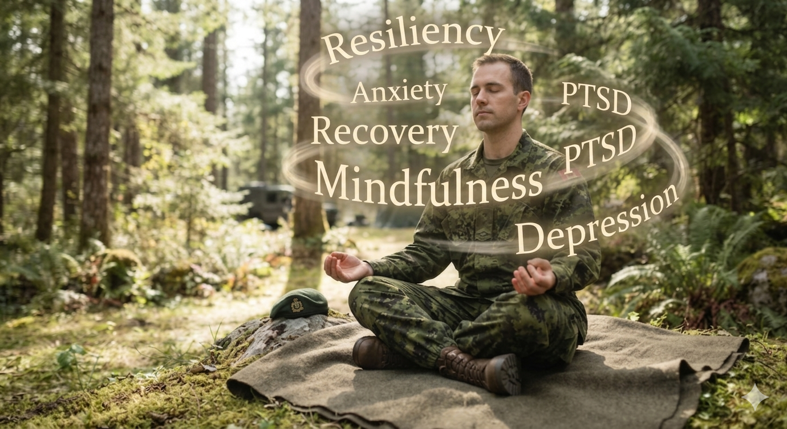
Meditation has become one of the most widely recommended practices for reducing stress, improving emotional well-being, and promoting relaxation. Millions of people practice meditation every day and experience meaningful benefits, including improved sleep, lower stress levels, and greater emotional resilience.
However, meditation is not a one-size-fits-all solution. Emerging research suggests that some forms of meditation—particularly prolonged silent mindfulness practices—may not be suitable for everyone. For individuals living with Post-Traumatic Stress Disorder (PTSD), Operational Stress Injuries (OSI), anxiety disorders, or depression, certain meditation techniques may increase emotional distress rather than relieve it.
Is Mindfulness Being Oversold?
Professor and Buddhist scholar Ron Purser has argued that mindfulness has increasingly become commercialized, referring to this trend as "McMindfulness." As meditation programs continue to grow in popularity, they are often promoted as simple solutions for complex mental health concerns.
While many instructors are highly qualified, not every meditation class is designed with trauma survivors in mind. Individuals living with PTSD or Operational Stress Injuries should seek programs led by professionals who understand the effects of trauma and can modify practices accordingly.
Important
This article is not intended to discourage meditation. Many people benefit greatly from meditation, and substantial research supports its ability to reduce stress and improve overall well-being. The purpose of this article is to explain why some forms of meditation may not be appropriate for everyone, particularly individuals living with PTSD or Operational Stress Injuries, and to encourage readers to explore trauma-informed approaches that feel safe, supportive, and effective.
What Does the Research Say?
While many people benefit from meditation, researchers have found that adverse experiences are more common than many realize.
A 2022 study involving approximately 1,000 participants found that more than 10 percent reported meditation-related adverse effects that significantly affected their daily lives, with some experiences lasting a month or longer.
Reported effects included:
Increased anxiety
Worsening symptoms of depression
Heightened PTSD symptoms
Feelings of dissociation or depersonalization
Intense fear or emotional overwhelm
In rare cases, psychotic or delusional experiences
Although these reactions are uncommon, they demonstrate that meditation should be viewed as one wellness tool, not a universal treatment.
What Is Guided Meditation?
One form of meditation that many people living with PTSD find easier to tolerate is guided meditation.
Unlike traditional silent meditation, where the goal is often to sit quietly and observe your thoughts without direction, guided meditation involves listening to a trained instructor who gently leads you through the experience. The instructor may speak throughout the session, offering calming reminders, breathing exercises, visualization techniques, or grounding prompts that help keep your attention focused.
For many people who have experienced trauma, this guidance can make a significant difference.
When we sit in complete silence, our minds naturally wander. For someone living with PTSD, those wandering thoughts can sometimes become intrusive memories, distressing emotions, or physical sensations connected to past traumatic experiences. This can leave the person feeling overwhelmed rather than relaxed.
Guided meditation helps reduce this risk by giving the brain something constructive to focus on. Instead of being alone with racing thoughts, participants are encouraged to gently return their attention to the instructor's voice, their breathing, or a calming mental image whenever their mind begins to drift.
Many guided meditations also include grounding techniques, such as noticing the feeling of your feet on the floor, paying attention to your breathing, or visualizing a place where you feel safe. These techniques can help regulate the nervous system and reduce feelings of anxiety or hypervigilance.
It is important to remember that guided meditation is not a treatment for PTSD by itself. Rather, it is one of many wellness tools that some people find helpful alongside peer support, counselling, medical care, exercise, and other evidence-informed approaches.
Just as every person's trauma is unique, so is every person's healing journey. Finding the right type of meditation may require some experimentation, patience, and self-compassion.
Trauma-Informed Alternatives That May Be More Helpful
Fortunately, meditation does not have to mean sitting silently with your thoughts. Many veterans, first responders, and public safety personnel find that structured activities provide a greater sense of safety and control while still promoting relaxation and emotional regulation.
Some trauma-informed approaches include:
Guided Meditation – Provides verbal direction throughout the session, helping maintain focus and reducing the likelihood of becoming overwhelmed by intrusive thoughts.
Grounding Exercises – Use the five senses to reconnect with the present moment when anxiety or traumatic memories begin to surface.
Gentle Breathing Practices – Help regulate the body's stress response by slowing breathing and calming the nervous system.
Walking Meditation – Combines movement with mindfulness, which many people find more comfortable than remaining completely still.
Trauma-Informed Yoga – Encourages gentle movement while allowing participants to remain in control of their bodies and choices.
Nature-Based Mindfulness – Focusing on the sights, sounds, and sensations of the natural world can promote relaxation without requiring prolonged inward focus.
Equine-Assisted Learning (EAL) – Working with horses encourages mindfulness through connection, observation, and emotional regulation. Many participants find this approach less intimidating than traditional meditation because it emphasizes presence, relationship, and non-verbal awareness. A common misconception about equine-assisted therapy is that participants are expected to ride a horse. In reality, most trauma-informed Equine-Assisted Learning programs, including those offered by OSI-CAN, are unmounted. Meaning, participants remain on the ground throughout the experience. Activities may include observing horse behaviour, leading a horse through simple exercises, grooming, or working alongside the horse under the guidance of trained facilitators.
Peer Support – Sometimes the most effective form of healing begins with simply talking to someone who understands.
You Are Not Alone
Healing from trauma is rarely a straight path. What works for one person may not work for another, and that is perfectly okay.
If traditional meditation has left you feeling more anxious, emotionally overwhelmed, or disconnected, it does not mean you have failed or that meditation is "not for you." It may simply mean that your nervous system needs a different approach.
Many veterans, first responders, and public safety personnel discover that guided meditation, grounding techniques, peer support, counselling, or other trauma-informed practices better meet their needs.
At OSI-CAN, we understand that recovery is deeply personal. Our mission is to inspire hope and support the well-being of veterans, first responders, public safety personnel, and their families through peer support, education, and connections to helpful resources.
If one approach has not worked for you, don't give up. Healing often begins by finding the approach that feels safe, supportive, and right for you.


Reviewing an mechanical manual recovered from a forgotten laboratory in Canada, I detected a mind-bending discrepancy right across the technical sketch of a high-power microscope. The researcher had scratched a dense, continuous alphanumeric cipher into the bottom border of the page. The mysterious inscription reads Sріnсіty https://spin-sity.com/ca/ looking exactly like a modern cryptographic code.